

Hi Neighbors,
Well it's been a time since I was on the site. I was busy retiring from one career and starting a new one with a penetration testing company.
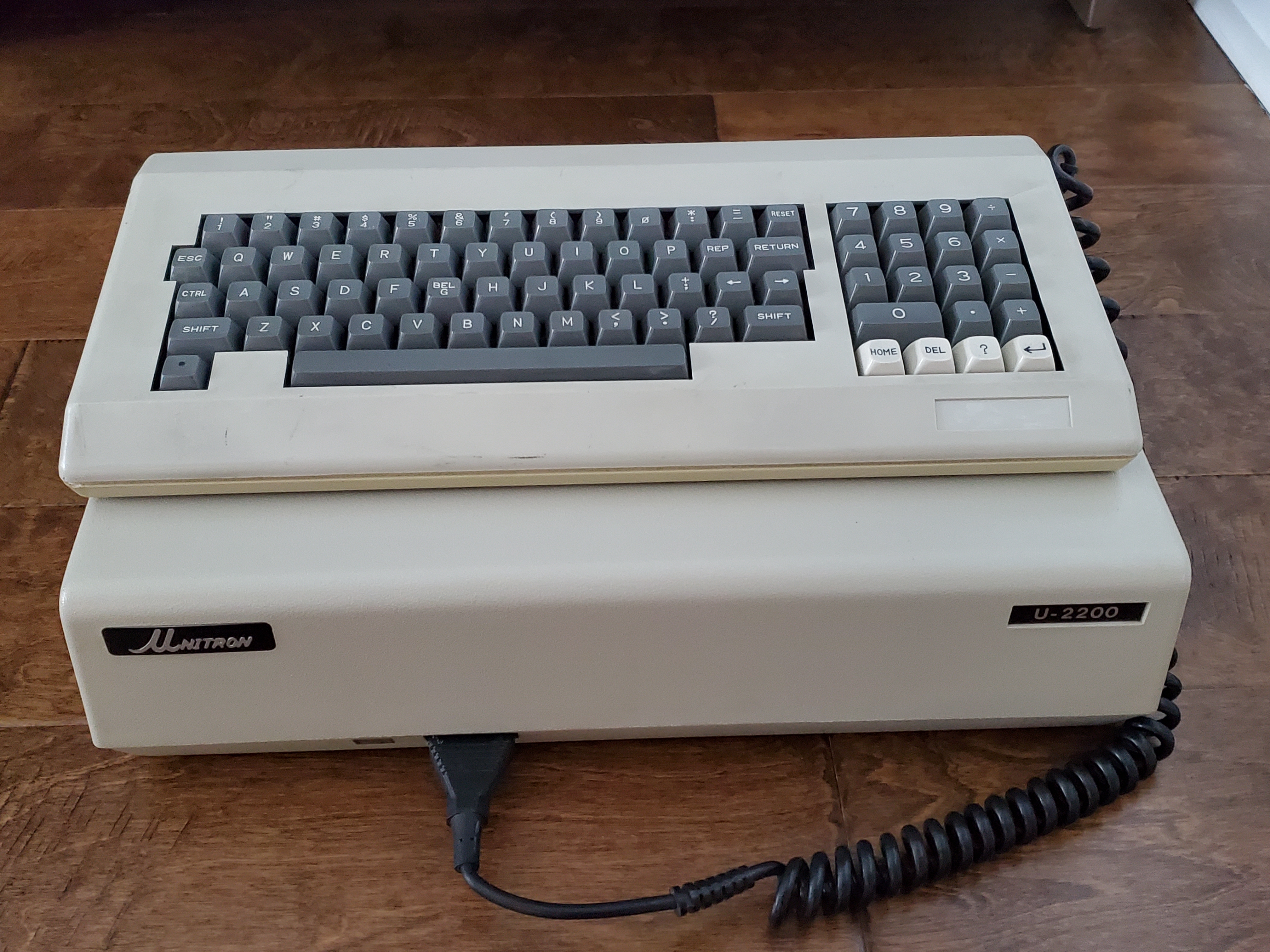
But that's not why I'm writing. Because of the overwhelming generosity and kindness of fellow Applefritter neighbor Robert Fantinatto, my U-2200 lives again with a genuine Unitron keyboard. I have a few video matters to troubleshoot, such as jiggly output and the bell not sounding through the keyboard, but other than that it lives! The keyboard was in great shape to start and looks even better after restoration with retro-brighting the keys and case. Frankly it was in such good shape, glueing a couple parts on the top and cleaning was all it needed.
Here is a photo of the final unit.
Super cool clone!
Yeah, I want that.
One of the great things about the Apple ][+, and one of the things that Apple hated, is that because it was created from standard TTL components, it didn't really have any specialized parts or ASICs and was easy to clone. And so it was, extensively. Even when they added logic to extend it, it tended to be minimal extensions, again keeping it relatively easy to clone. The same of course was true of the IBM PC because it was mostly made from Intel, Motorola, and standard memory chips. On the other hand, I can't think of any clones at the time for the Commodore 64 or Atari 400/800 which had specialized video and sound chips.
That looks extremely solid. How much does it weigh?
I find it fascinating that they managed to squeeze in the word "BEL" above the "G", but then just gave up for the at-sign over the P and caret over the N.
That...and the fact tht the C64 / VIC sold for rock bottom prices, making cloning a certain money losing venture.
Commodore lost money on a lot of C64 and VIC-20 units they sold, as well as did TI on 99/4a and Atari on 400/800. They were engaged in a huge price war which Commdore "won" as a pyrrhic victory. TI droppped out early, but Atari eventually went bankrupt and Commodore did too, although it took a little longer.
So it would have been hard to make money cloning a money losing product... The Atari and TI, etc... none of those had a huge enough market share to warrant the effort to clone them anyway, even if they'd been expensive enough to have margin.
The reason Apple and IBM were profitable to clone was that they were premium priced machines. It was possible to build a clone, sometimes even with extras for less money. And you could usually do it with decent quality, albeit, some of the generic clones did cut some corners on materials and/or workmanship.
One of the few budget machines that was cloned that I can think of was the Dragon clone of the TRS-80 CoCo. And I think that may have been more due to the dynamics of UK/European markets. Also not sure how profitable that was given you don't see a lot of Dragons around. The CoCo wasn't a massive seller to begin with.
Software Janitor wrote:
Your analysis of the 8-bit market dynamics makes sense to me.
I'm not sure that the Dragon was a "clone" in the usual sense, although I admit I don't know much about it. Unlike Apple, Radio-Shack/Tandy tended to purchase the right to manufacture a product from another company and then slapped their name on it. For example, the TRS-80 Model 100 was a rebadged Kyocera Kyotronic-80 with very few changes in the ROM. There were "clones" of the Model 100, but only in the sense that Kyocera also licensed their blueprint to other companies: to NEC in Japan for their PC-8201 and to Olivetti in Italy for their M10.
While it wouldn't have been hard to clone the TRS-80 Color Computer, since it was extremely similar to the reference design Motorola released for the 6809 chip, I wonder about the software compatibility. The Dragon seemed to have many of the same games as were advertised in the Radio-Shack catalogs, even with the same wording, which makes me think they had to have been in partnership. But, I can also totally see Microsoft licensing the CoCo BASIC ROM to Dragon without getting Radio-Shack's approval, in a similar way to how they sold MS DOS and GW BASIC for the clones of IBM's PC.
Radio Shack's computers would have all been pretty easy to clone from the hardware standpoint given that they are all made with off the shelf chips. The CoCo is a pretty obvious combination of Motorola parts, the 6809 and the 6847 video chip . As yuo mentioned, pretty close to the Motorola reference design example. Their Z80 based machines, Model 1 to Model 4 are also pretty much built with off the shelf parts. Unlike Commodore who had their own in-house chip designers and fab (MOS, later CSD) and Atari which had Jay Miner's team designing custom chips, Radio Shack didn't really design or fab any of the chips in their 8 bit machines. Radio Shack was really more of a retail marketing company than a design or manufacturing company.
I don't know a lot about the Dragon either, I know they can be made to run Microware OS9 like the CoCo, and it was my understanding that they were at least somewhat compatible. From what I've read they both use a similar BASIC and pure BASIC programs can be loaded and run on them but memory arrangement is different to where assembler/compiler written software needs to be assembled/compiled specificly for each one.
Hi, I would need the ROMs for my Emulator. There are two sets with 12K each, one for the CP/M machine and one for Apple II functionality. I am interested on both sets. I guess the Apple part is similar to the ROMs of the 2000 but the CP/M compatible ROMs of the 2200 are completely different. Thank you.
In post #7, 'softwarejanitor' wrote:
softwarejanitor wrote:
Commodore lost money on a lot of C64 and VIC-20 units they sold, as well as did TI on 99/4a and Atari on 400/800. They were engaged in a huge price war which Commdore "won" as a pyrrhic victory. TI dropped out early, but Atari eventually went bankrupt and Commodore did too, although it took a little longer.
Uncle Bernie comments (a few years too late, did not notice this thread until it was revived today):
The custom ICs in these computers were not adopted to thwart copycats, although this was a welcome side effect. The reason for the use of custom ICs was to make these computers economically viable - in principle, they could have been built using several hundred TTL ICs in lieu of the custom ICs, but these would consume so much PCB board space and so much power, needing forced air cooling and a more sophisticated enclosure design for proper air flow, increasing costs to a level where no hobbyist could ever afford such a computer.
But the custom ICs as such are not necessarily cheaper to have than the equivalent handful of TTLs, because they incur huge NREs for the design and development. Unless huge quantities of such custom ICs are being produced, they can be very expensive per IC. So, if the projected sales numbers of the computers cannot be achieved, the whole proposition of using custom ICs can turn into a financial disaster. Those companies who used full custom, handcrafted NMOS ICs were at a disadvantage compared to those who used cheaper semicustom ICs (like gate arrays, or the ULAs used i.e. by Sinclair Research and Tangerine Computer Systems).
Commodore had the advantage that they had their own semiconductor manufacturing operation (MOS Technology) so they could obtain their full custom NMOS ICs without adding any profit margins to the ICs themselves. But it seems that Jack Tramiel also forgot to add profit margins to the C64 ;-)
Atari had originally intended to use the CTIA/GTIA custom chips in a next generation version of the Atari VCS but Warner Bros. management decided to use it in a home computer instead - this is why the ANTIC was added, and POKEY for sound, keyboard and serial I/O. With the homecomputer line selling approximately 10 x less units that plain TV game consoles, this was a money losing proposition from the beginning.
If we look at this period of time with hindsight, it seems that these companies never generated enough sales for their computers to justify the expense for the custom ICs they did use. As a consequence, they never had the money to develop more advanced versions of their custom ICs with better graphics and sound. Commodore had an even worse problem - the MOS Technology wafer fab was already outdated in the mid 1980s and they had no money to upgrade the fab to a smaller process node. So they fell behind technology wise.
But what really killed the "homecomputer" as such was the rise of the PC and the dedicated TV game consoles - the PC could do real business work but initially had lousy graphics unfit for games, while the TV game consoles had much better graphics and sound and were optimized for gaming, but had no keyboard and no mass storage devices (and consequently were cheaper to produce).
In the end, the strange animal "homecomputer" which tried to do both small business work and gaming had to die out as the market did split into two main trajectories, plain business computers and plain game consoles. High end gaming on the PC only took off many years later, when better graphics and sound cards became available. But never was as cheap to own as a dedicated TV game console.
The Apple II was an exception, because it had the slots on the motherboard (an idea the IBM PC developers stole from Apple) and could be turned into a small business system by adding a 80 character card, a printer card, and a DISK II card. The Apple IIe used custom ICs (MMU and IOU) but these were economically viable as the Apple IIe is estimated to have sold around 4.5 million units. I think the IWM was primarily developed for the early Macintosh but was also specified for possible use in the Apple II series ('Liron' card and the Apple IIc). The emphasis on the Macintosh explains why bugs within the IWM which handicapped its use in the Apple II family never were fixed (until I designed the 'IWMless', but that's another story).
If we look at the "Golden Age of Home Computers" (circa 1977-1987, depending on the source, some sources extend it into the early 1990s, but IMHO this extension is not valid for 8-bit types, whose sales crashed in 1988), and with the blessing of hindsight, we can now make the somewhat cynical statement that this "Golden Age" was not "Golden" at all, but was littered with bankrupt manufacturers and flooded with red ink (lost money). Still, for a homecomputer owner, it was a fascinating and exciting time, because we were part of an Avant-garde movement, based on a new technology which had been inaccessible for hobbyists before. All this excitement went away when we were locked out from hardware and software hacking which came with the proprietary TV game consoles and their crypto chips to thwart any manipulation by the users. I never owned such a thing ... because I refuse to spend my money on computers I can't hack and can't run my own software on.
Fond memories ... and I hope it was worth to write them down here on Applefritter.
- Uncle Bernie